◆ 2026-10-29·Ras Tanura · Saudi Arabia
Ras Tanura update, 29 October 2026
On 28 October, the morning after the Houthis claimed a missile strike on Ras Tanura, Sentinel-2 found the refinery's cracking unit cold. It had read hot on every clear pass since 1 May. A fresh black mark of 1.7 hectares, the kind of soot a fire leaves, lies 100 metres north of it. The same morning, the two crude terminals at Ras Tanura held more tanker capacity than on any day since our record starts in September 2025: 19.3 million barrels.
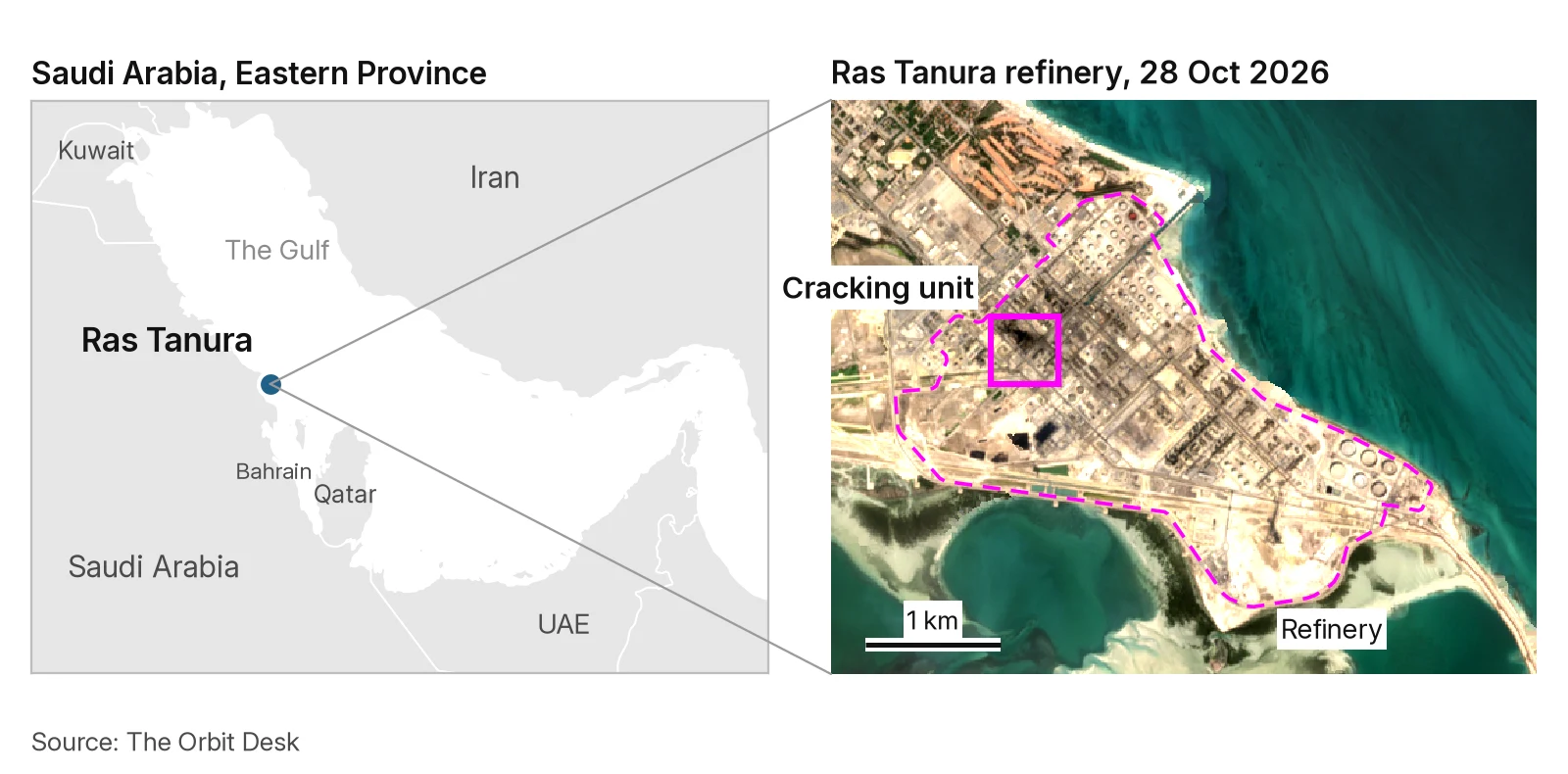 Ras Tanura on the Gulf coast of Saudi Arabia. Right: the 550,000 b/d refinery on Sentinel-2, 28 October 2026; the square marks the cracking unit, 500 m across.
The unit went cold between 25 and 28 October
A hot unit lifts the 2.2 µm shortwave infrared band above the 1.6 µm band. On 25 October the unit's 20-metre pixel read 0.62 against 0.32. On 28 October both bands read 0.17, the same as the ground around it. A flare 400 metres to the south still saturated both bands on the 28 October image, so the cold reading is neither haze nor a shifted image.
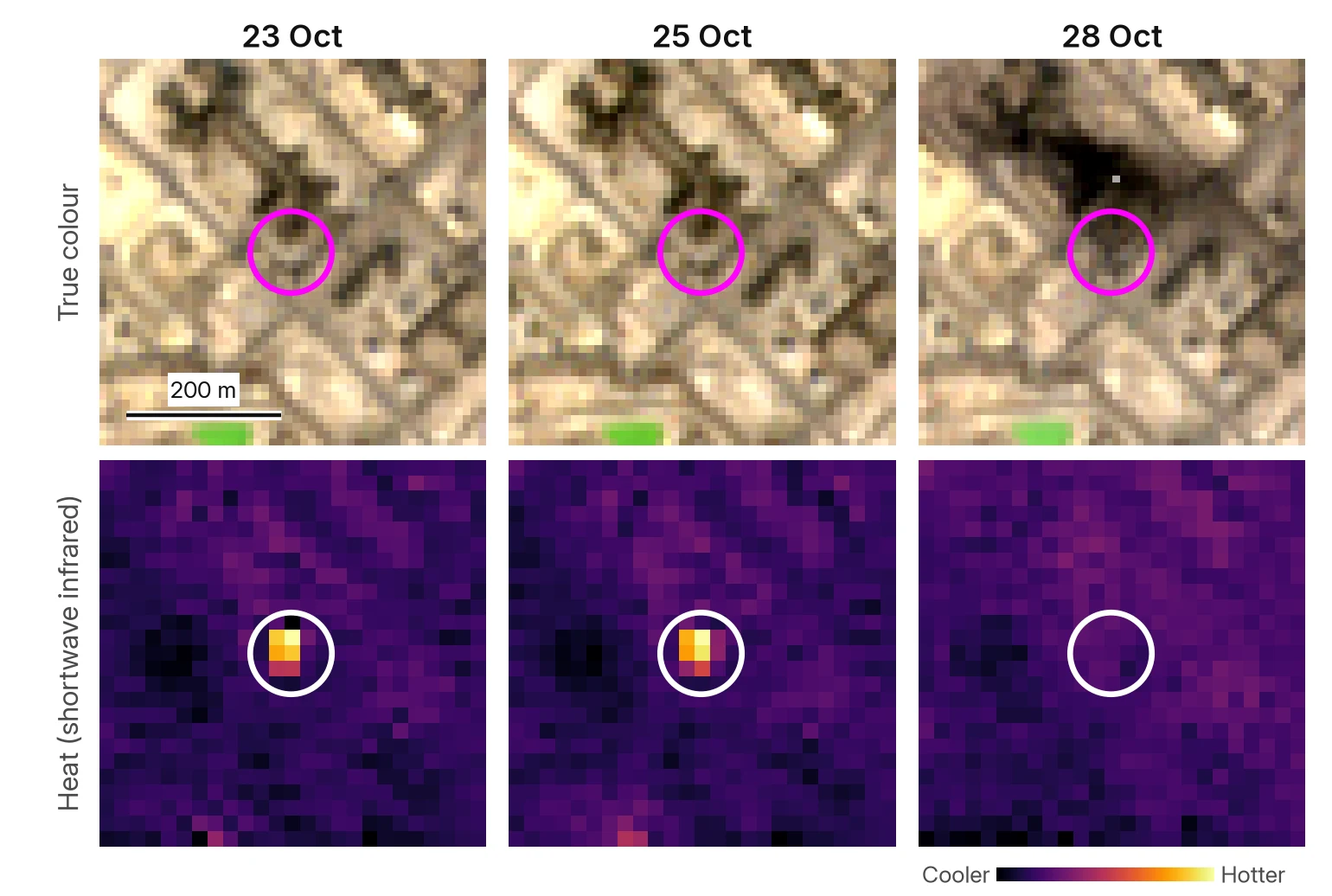 Sentinel-2 on 23, 25 and 28 October 2026, 500 m across, centred on the cracking unit. Top: true colour. Bottom: heat in shortwave infrared. Contains modified Copernicus Sentinel data 2026.
The true-colour row shows a second change. On 28 October a dark patch of about 1.7 hectares (350 by 280 metres) covers the ground just north of the unit. It is absent on 23 and 25 October, and it is the only newly darkened area in a 5 by 4 kilometre window around the refinery.
In March the unit stayed off seven weeks past the refinery's restart
The unit has stopped twice in the past 12 months. Aramco shut the refinery on 2 March after a drone strike. A restart was reported for 13 March, yet the unit read cold on every clear pass from 14 March to 18 April. It read hot again on 1 May, two months after the strike.
Both crude terminals at their busiest on 28 October
On 28 October tankers occupied all six loading buoys at Ju'aymah, each a very large crude carrier, and five more lay at Ras Tanura's Sea Island and North Pier. Together they could carry 19.3 million barrels. Before March the two terminals averaged 11.9 million barrels alongside. After the strike that fell to 1.1 million in April and stayed under 4.5 million through August. It came back to 9.6 million in September and 9.3 so far in October.
Crude kept moving; the refinery took the hit
Saudi Arabia said it intercepted three ballistic missiles fired at the Eastern Province on 27 October, and reports described a contained fire near the export terminal. The Houthis claimed a hit on the refinery. From orbit, the terminals loaded at their busiest while the refinery's cracking unit sat cold beside a fresh soot mark.
A cracking unit turns heavy gasoil into gasoline. Without it, Ras Tanura can keep running crude but makes less gasoline and more heavy product. Aramco publishes no capacity for the unit, so we put no barrel figure on the loss. In March the unit came back seven weeks after the refinery's announced restart. If this stop runs as long, the unit stays cold into December, and a restart headline will say little about Ras Tanura's gasoline output.
Four Sentinel-2 passes in the next week
Sentinel-2 passes over Ras Tanura on 30 October at 07:10 UTC, 1 November at 07:13, 2 November at 07:21 and 4 November at 07:10. Each image reaches us about four hours after the pass, and each covers the refinery and both terminals. Heat back at the unit's pixel would mark a restart. A wider dark mark or other cold units would point to a larger outage.
What the figures cover
Running or off comes from the unit's 20-metre Sentinel-2 pixel, read on every pass since October 2024 and kept when the pixel is clear: 286 of 354 passes. The unit counts as running when the 2.2 µm band clears the 1.6 µm band by a margin set in an empty gap of the readings, so any threshold inside that gap gives the same states. Each clear pass holds until the next one. Sentinel-2 passes in daylight every two to five days, so stops shorter than the gap between clear passes go unseen, and the current stop rests on one image so far. The unit is identified from the plant layout; Aramco publishes no unit-level data.
Tankers are counted on satellite images at Ju'aymah's six buoys and at Ras Tanura's Sea Island and North Pier, and each is credited with the capacity of its size class, about 2 million barrels for a very large crude carrier. Capacity alongside is not the volume loaded. The chart keeps the days on which both terminals were read; the 25 October reading undercounts Ju'aymah.
Imagery: contains modified Copernicus Sentinel data 2024–2026.